


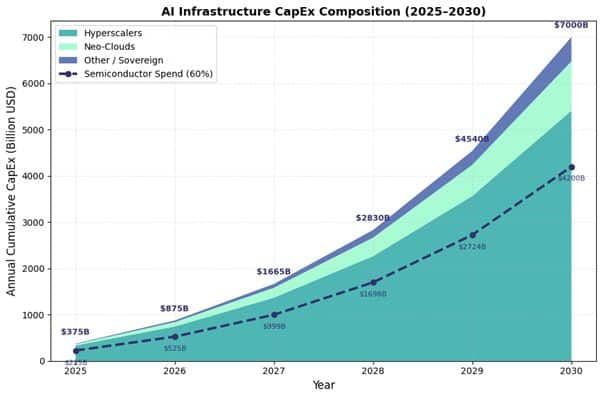
The artificial intelligence boom has changed the semiconductor industry from the ground up. What began as a surge in demand for specialised computing hardware has developed into a broader infrastructure cycle involving processors, accelerators, networking equipment, memory, software, and data-centre capacity. For semiconductor investors, this creates an important question: which companies can convert rising AI demand into durable revenue growth and improving profitability?
Advanced Micro Devices has become an important company to watch in this environment. Its position across data-centre CPUs, AI accelerators, and related computing technologies gives it exposure to several parts of the infrastructure market. At the same time, the semiconductor industry remains cyclical, meaning strong demand does not automatically translate into uninterrupted growth. Understanding AMD therefore requires looking beyond headline AI enthusiasm and examining data-centre demand, margins, competitive positioning, and the broader semiconductor cycle.
Data-Centre Demand Is Reshaping Semiconductor Growth
Modern AI workloads require enormous amounts of computing power. Training sophisticated models and running them at scale can require substantial investment in servers, accelerators, networking, storage, and power infrastructure. As businesses increasingly integrate AI into search, software, analytics, automation, and other applications, cloud providers and data-centre operators have continued investing in infrastructure capable of handling these workloads.
AMD participates in this market through its EPYC server processors and Instinct accelerator family. Server CPUs remain important because AI infrastructure still requires general-purpose computing alongside specialised accelerators. This gives AMD exposure to conventional data-centre spending while also providing a route into the rapidly expanding AI accelerator market.
The broader industry trend is significant because semiconductor demand is no longer being driven solely by traditional PC and smartphone replacement cycles. Data centres represent a different type of customer environment, where performance, power efficiency, total cost of ownership, and software compatibility can influence purchasing decisions. Industry analysts and technology companies broadly recognise AI infrastructure as a major source of semiconductor demand, although spending patterns can fluctuate as customers adjust capital expenditure plans.
Margin Expansion Matters as Much as Revenue Growth
Revenue growth tends to receive the most attention during an AI boom, but profitability can tell investors much more about the quality of that growth. A semiconductor company can increase sales rapidly while seeing limited improvement in earnings if production costs, research spending, manufacturing expenses, or pricing pressures absorb much of the additional revenue.
For AMD, higher-value data-centre products have the potential to influence the company’s overall product mix. Enterprise and data-centre customers often prioritise performance and efficiency rather than simply choosing the lowest-priced component. When a company successfully sells more sophisticated products with stronger economics, a larger contribution from those products can support gross-margin expansion.
That dynamic is particularly relevant when considering AMD’s AI strategy. Investors need to distinguish between simply selling more chips and building a business in which premium products contribute meaningfully to profitability. Gross margin trends, operating expenses, product mix, and research-and-development investment can help reveal whether AI demand is translating into sustainable financial improvement.
AMD’s Position Within the Competitive Landscape
AMD operates in an intensely competitive semiconductor market. Its opportunities in data centres and AI exist alongside established competitors with significant financial resources, engineering capabilities, customer relationships, and software ecosystems. The competitive environment means product specifications alone do not determine market success.
In AI computing, software compatibility is particularly important. Customers building large-scale AI systems want hardware that can work efficiently with existing development tools and applications. AMD has therefore invested in its software ecosystem alongside its accelerator hardware. The long-term importance of these investments will depend partly on whether developers and enterprise customers increasingly adopt AMD-based AI solutions.
This competitive setting makes relative strength an important concept. Rather than considering AMD’s performance in isolation, investors can examine how its revenue growth, margins, product launches, data-centre presence, and market performance compare with other semiconductor companies. For anyone researching AMD NASDAQ, this relative perspective can provide more useful context than looking at a single quarterly result or short-term share-price movement.
Understanding the Semiconductor Cycle
AI may represent a powerful structural trend, but semiconductors remain cyclical businesses. Companies can experience periods of intense demand followed by inventory corrections, customer spending pauses, pricing pressure, or slower replacement cycles. Even when long-term demand remains healthy, the path between investment cycles can be uneven.
Data-centre spending can also become concentrated among a relatively small number of very large customers. If cloud providers increase capital expenditure aggressively, suppliers can benefit from strong orders. If those customers temporarily moderate investment after major infrastructure expansion, semiconductor revenue growth can become more difficult. This does not necessarily invalidate the underlying AI trend, but it demonstrates why investors should separate secular demand from short-term purchasing cycles.
Conclusion
AMD’s role in the AI semiconductor cycle extends beyond the excitement surrounding artificial intelligence. Its exposure to data-centre CPUs and AI accelerators places the company within a major technology investment trend, while its financial performance provides a way to assess whether that opportunity is translating into sustainable business results. Data-centre demand, product mix, margin expansion, competition, and customer spending patterns will all remain important indicators.
For readers following AMD, the most useful approach is to think in terms of business fundamentals and cycles rather than short-term headlines. AI infrastructure investment may continue creating significant opportunities for semiconductor companies, but the benefits will depend on execution, competitive positioning, profitability, and valuation.